
Pre-AMSA Inspection Australia
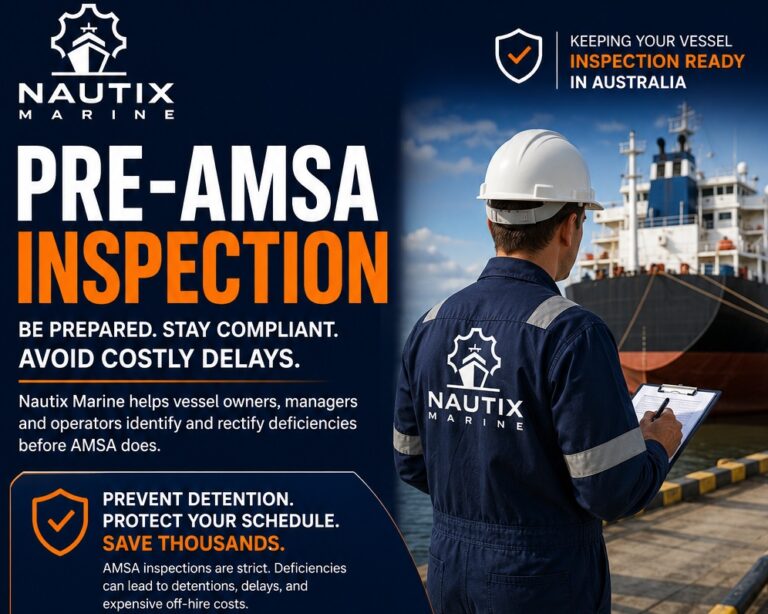
Our Pre-AMSA Inspection service helps vessel owners, ship managers and technical superintendents identify deficiencies before AMSA inspections, reducing the risk of detention, delays and costly corrective actions.
Pre-AMSA inspection Services
Nautix Marine Solutions provides professional Pre-AMSA Inspection services throughout Australia, helping vessel owners, ship managers, technical superintendents and operators prepare for Australian Maritime Safety Authority (AMSA) Port State Control (PSC) inspections.
Our experienced marine inspectors conduct comprehensive vessel assessments to identify deficiencies before an AMSA inspection takes place. We review critical safety systems, statutory certificates, lifesaving appliances (LSA), firefighting equipment (FFA), mooring equipment, accommodation ladders, gangways, lifting appliances and operational documentation to help reduce the risk of detention, delays and costly corrective actions.
With extensive experience supporting commercial vessels, bulk carriers, container ships, tankers, offshore support vessels and general cargo ships, Nautix Marine Solutions delivers practical recommendations and fast reporting to ensure vessels meet Australian regulatory requirements before arrival.
Whether your vessel is arriving in Melbourne, Sydney, Newcastle, Brisbane, Gladstone, Fremantle, Dampier, Port Hedland or Darwin, our Australia-wide capability enables rapid mobilisation and efficient inspection support.
What Is Included In A Pre-AMSA Inspection?
Our Pre-AMSA Inspection service may include:
- Port State Control (PSC) readiness assessment
- AMSA detention risk evaluation
- Fire Fighting Appliance (FFA) inspection
- Lifesaving Appliance (LSA) inspection
- Mooring winch and brake assessment
- Accommodation ladder inspection
- Gangway inspection
- Pilot ladder compliance verification
- Navigation equipment verification
- ISM documentation review
- Statutory certificate verification
- Deficiency identification and reporting
- Defect rectification recommendations
- Follow-up compliance verification
Why Conduct A Pre-AMSA Inspection?
A professional Pre-AMSA Inspection can help:
- Reduce the risk of AMSA detention
- Identify deficiencies before arrival
- Minimise off-hire costs
- Avoid port delays and operational disruption
- Improve vessel safety and compliance
- Prepare crews for Port State Control inspections
- Protect charter schedules and commercial commitments
Ports We Service
Nautix Marine Solutions provides Pre-AMSA Inspection services at major Australian ports including:
- Melbourne
- Sydney
- Newcastle
- Brisbane
- Gladstone
- Fremantle
- Dampier
- Port Hedland
- Darwin
- Adelaide
- Geelong
- Townsville
Our certified technicians are committed to delivering services that minimize downtime and enhance operational safety. Whether for routine maintenance or post-repair validation, trust Nautix Marine Solutions to keep your lifting operations compliant and efficient.
Pre AMSA Inspection Checklist for Vessels
If AMSA is due alongside a busy schedule, the risk is rarely the inspection itself. It is the small gap that was missed beforehand – an expired certificate, an incomplete service record, a faulty light, a winch issue that has been tolerated one voyage too long. A practical pre AMSA inspection checklist helps operators find those gaps early, reduce avoidable defects and keep the vessel ready for service.
For commercial vessel owners, ship managers and engineers, pre-inspection readiness is not just an administrative exercise. It is a control measure for uptime, safety and compliance exposure. When a vessel presents poorly, even minor deficiencies can trigger delays, follow-up actions and unnecessary pressure on the crew and shore team. When it presents well, the inspection process is usually more efficient, more predictable and easier to close out.
What a pre AMSA inspection checklist should actually do
A useful checklist is not a generic form filled out the day before attendance. It should function as a structured review of the vessel’s current condition against statutory requirements, safety-critical equipment status, maintenance records and housekeeping standards. It should also help identify what can be rectified immediately and what needs specialist support before AMSA steps on board.
That matters because inspection outcomes are rarely shaped by one major failure alone. More often, they reflect a pattern. Incomplete documentation, weak planned maintenance follow-through, overdue servicing, poor storage, degraded signage and unresolved defects can collectively suggest weak control of the vessel. A strong checklist helps prevent that pattern from developing.
Pre AMSA inspection checklist: the core areas to review
The starting point is documentation. Before looking at equipment, confirm that all statutory certificates, class records where applicable, manuals, logbooks and service reports are current, available and consistent. Inspectors will look for evidence that the vessel is being managed properly, not just that equipment appears present on the day.
Crew certification and vessel certificates should be checked against expiry dates and trading requirements. Planned maintenance records should show that safety-critical tasks are being completed at the required intervals. Defect logs should be current, with clear evidence of rectification or control measures where a permanent repair is pending. If a temporary repair has been made, it needs to be properly documented and defensible.
Safety equipment is the next priority. Liferafts, lifejackets, EPIRBs, SARTs, fire extinguishers, fire detection systems, fixed firefighting systems and emergency lighting should all be inspected for service status, condition, accessibility and correct stowage. Even where third-party servicing has been carried out, the vessel still needs to present equipment in a ready state. An in-date service tag will not compensate for poor access, visible damage or missing signage.
Fire and abandon ship arrangements should also be reviewed from an operational perspective. Muster lists, emergency instructions, drills and crew familiarity all matter. Inspectors may look beyond the hardware and assess whether the vessel can actually respond effectively in an emergency. That is where paperwork-only preparation often falls short.
Navigation and communication equipment should be checked for operability, calibration status where relevant and record keeping. This includes radios, AIS, radar, GPS, navigation lights, sound signalling appliances and bridge alarms. A recurring issue on many vessels is not total equipment failure, but minor defects that have become normalised by the crew. If a buzzer is isolated, a light is intermittent or a display fault has been left unresolved, it should be addressed before inspection.
Machinery spaces require particular attention because they often reveal the true standard of onboard maintenance. Bilges should be clean and controlled, leak sources identified, insulation in good condition, guards in place and emergency shutdowns clearly marked and functional. Fuel, lube oil and hydraulic systems should be checked for integrity, while pipe identification, valve labelling and isolation arrangements should be clear and maintained.
For deck equipment, operators should pay close attention to mooring winches, cranes, lifting appliances, hooks, wires and associated safety devices. Where the vessel uses lifting gear in service, inspection and testing status must be current and traceable. This is not an area where assumptions help. If records are incomplete or equipment condition is questionable, it needs to be investigated before AMSA raises it.
Where inspections are often lost before they begin
A vessel can be technically compliant and still attract unnecessary scrutiny if presentation is poor. Housekeeping remains one of the clearest indicators of operational discipline. Damaged deck surfaces, loose gear, poor storage, oil staining, blocked access ways, faded markings and inconsistent signage suggest that other less visible controls may also be weak.
Another common issue is fragmented records. Many operators have the right documents, but not in a form that is easy to verify. During inspection, delays in producing certificates, service reports or maintenance evidence can undermine confidence quickly. The practical fix is straightforward – assemble inspection-critical records in a single, current set that the master or chief engineer can present without searching across multiple systems or old email chains.
There is also the issue of unresolved minor defects. These are the defects crews know about, have worked around and intend to fix at the next opportunity. From an operational standpoint, that can feel reasonable. From a compliance standpoint, repeated tolerance of known defects can become a bigger problem than the defect itself. A pre-inspection review should surface these items and force a decision – rectify, formally control or escalate.
How to use a pre AMSA inspection checklist properly
The best results come when the checklist is used early enough to allow action, not just verification. For most commercial vessels, that means carrying out the initial review at least several days before the expected inspection window, then completing a final close-out check once rectifications are done. Leaving all checks to the final 24 hours tends to expose issues that cannot be resolved without delaying attendance or sailing.
Responsibility should also be split logically. Masters, chief engineers and shore managers each see different risks. Documentation and certification can often be confirmed ashore, while onboard equipment condition, signage, escape routes and machinery space standards need direct vessel-level review. If one person is expected to cover all areas in isolation, gaps are more likely.
It is also worth distinguishing between a routine internal check and a true readiness assessment. A real pre-inspection review should test whether the vessel can withstand independent scrutiny. That means asking harder questions. Is the record trail complete? Would the crew answer consistently on emergency arrangements? Are service intervals and defect close-outs fully defensible? If not, more work is needed.
When specialist support makes sense
Some deficiencies are easy to close out internally. Others require certified service providers, technical repair capability or external verification. FFA and LSA servicing, load testing, wire renewal, crane inspections, mooring winch issues and AMSA defect rectification often sit in that category. The commercial mistake is waiting until an inspection identifies the problem formally, when the vessel is already exposed to delay.
A competent pre-attendance partner can add value by reviewing likely inspection pressure points, checking records against current requirements and carrying out targeted rectification before the regulator arrives. That is especially relevant for operators managing ageing assets, complex offshore support vessels or tight turnaround schedules where downtime has direct cost implications.
For that reason, many operators treat pre-inspection work as part of planned operational assurance rather than a last-minute compliance task. The return is usually seen in fewer surprises, faster close-out and better confidence across both vessel and shore teams.
A practical standard for inspection readiness
A strong pre AMSA inspection checklist should leave you with clear answers in four areas: are the certificates current, are the records complete, is the equipment serviceable and does the vessel present as well controlled. If any one of those areas is weak, the inspection risk increases.
For serious commercial operators, readiness is not about trying to look good for a single visit. It is about proving that the vessel is being maintained, documented and operated to a standard that holds up under scrutiny. That is the benchmark worth working to – not because AMSA is due, but because reliable compliance is part of reliable operations.

GET AN INSPECTION QUOTE
⚓ PRE-AMSA INSPECTION
Avoid Detention. Protect Your Schedule.
✓ PSC Readiness Assessment
✓ Critical Deficiency Identification
✓ Safety Equipment Verification
✓ Documentation Review
✓ Defect Rectification Support
Need Help? Talk to Nautix Marine